Open-source incident intelligence
FCAPSule
AI investigation. Lasting intelligence.
Connect the evidence. Understand the incident.
Give the next investigation a head start.
Collective makes relevant past cases available to other investigations.
Your observability stack stays in place.
- Prometheus
- OpenSearch
- Kubernetes
Investigate
From the alert
to the explanation.
FCAPSule follows the evidence across logs, metrics and workload configuration. It brings back a likely explanation, the checks behind it, and a useful next step.
Inside an investigation
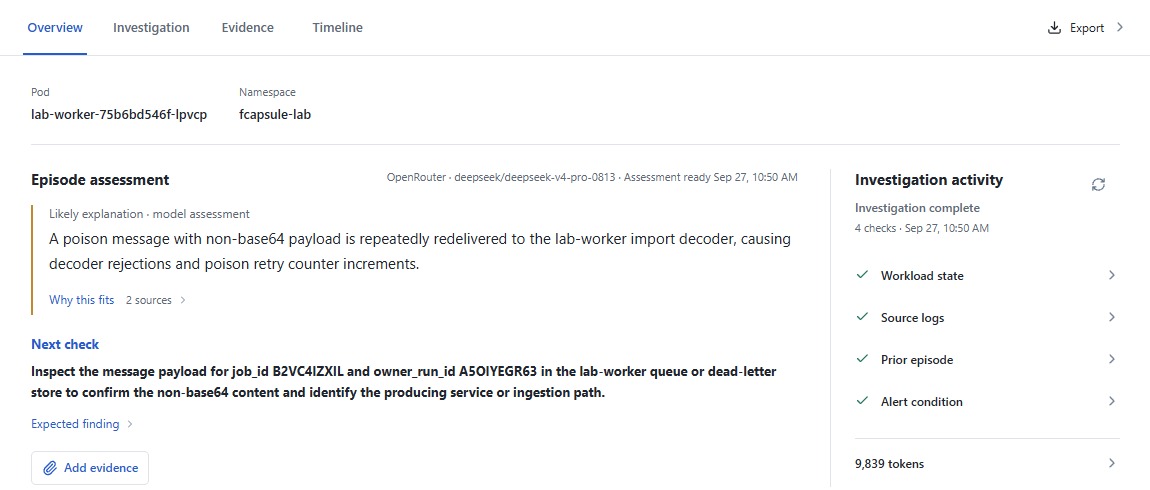
Retained lab case / Worker retriesThe symptom
The worker keeps failing.
An alert starts the investigation. It identifies the affected workload, but doesn't explain what is driving the failures.
Repeated processing failures
Fault signalThe evidence
A message comes back.
The decoder rejects it again.
The agent connects repeated decoder failures with a redelivered malformed payload. It checks the workload, source logs and prior episodes.
The useful next step
Inspect the message.
Then trace its producer.
The likely explanation is a malformed payload being repeatedly processed. The producer remains unconfirmed, so the assessment separates the evidence from the hypothesis.
Preserved in the capsule
- Evidence behind the explanation
- Checks already performed
- What still needs confirmation
See the original lab assessment
Preserve
The logs expire.
The evidence stays.
Keep the part of the incident you'll need again.
A capsule preserves selected log evidence, metric windows, configuration snapshots and investigation results. Engineers can revisit that record after the source systems have discarded their raw telemetry.
- At the source
- High-volume telemetry, governed by its own retention policy.
- In the capsule
- Selected incident evidence and the reasoning it supported.
- In a future investigation
- A retained reference, even when the original data is no longer available.
Capsules follow your retention settings. They preserve selected evidence, not a complete backup of the monitoring stack.
Remember
Collective
One team's investigation.
Another team's head start.
Connect multiple independent FCAPSule instances to the same memory. Each can contribute selected incident knowledge and retrieve relevant cases from the others.
The AI can compare a new incident with past observations, configurations and hypotheses. More relevant experience becomes available to reason with, without retraining a model.
 CollectiveShared memory
One case becomes a reference.
Each instance decides what to share. The selected observations and hypotheses keep their provenance.
Shared observations · Separate hypotheses
Find overlap without assuming a cause.
Related signals make previous cases discoverable. A shared symptom is a lead to investigate, not proof of the same failure.
The next agent doesn't start from zero.
FCAPSule can retrieve past cases, even after their source telemetry expires. Its AI reasons with those records alongside the new evidence.
Illustrative instances and relationships, not live deployment data.
FCAPSule investigates. Collective remembers.
The connection is optional. Model calls stay in FCAPSule; Collective stores and retrieves shared knowledge without running LLMs.
Built for the monitoring team
Work with the access
you already have.
You don't have to own the application to investigate it. FCAPSule works through configured observability sources and read-only checks.
Prometheus
Alert conditions and performance across the incident window.
OpenSearch
Relevant log evidence, with the source behind each observation.
Kubernetes
Workload state, configuration and relationships between resources.
Your evidence
Add a screenshot, a note or an audio observation to extend the investigation.
Open source.
Open to inspection.
Explore the implementation, deployment guides and current boundaries.
What to know before deploying
FCAPSule is an actively developed university project. Assessments are hypotheses for human review; it does not execute fixes. Evidence selection cannot preserve every detail of expired telemetry. Shared cases retain the distinction between observations and hypotheses. This site does not claim production adoption or measured operational savings.
Read the current boundaries ↗